The use of force continuum is the framework agencies use to match an officer’s response to the level of resistance or threat they face, moving from officer presence and verbal commands up through less-lethal tools and, only when necessary, lethal force.
For a training coordinator building or updating department policy, the continuum is not a chart to post on a wall. It is the reference point that shapes how officers are trained, how incidents are reviewed, and how a department explains its decisions afterward.
Every agency that fields less-lethal equipment needs officers who understand exactly where that equipment sits in the response sequence, and why. Get that placement wrong in training, and you get it wrong in the field, which is where policy gaps turn into liability.
This piece walks through where less-lethal options fall on the continuum, how de-escalation factors in before force is used at all, and what “excessive force” means in practice.
What Does the Use of Force Continuum Actually Cover?
Most continuum models run through five to six stages: officer presence, verbal direction, soft empty-hand control, less-lethal tools such as launcher-based systems, and lethal force, with a broad de-escalation layer running underneath.
The Canadian Association of Chiefs of Police built its National Use of Force Framework around a similar structure, and agencies that formally track use of force typically measure both the level of resistance shown by a subject and the level of force applied, based on a defined continuum.
That framework gives training coordinators a consistent standard to teach against and gives departments a defensible record when they review an incident.
How Officers De-Escalate Before Force Enters the Picture
Verbal de-escalation sits below every physical response option on the continuum, and it is meant to resolve as many encounters as possible before drawing any tool. De-escalation strategies typically include slowing the interaction down, creating distance and time, and using clear verbal direction to reduce a subject’s agitation without physical contact.
De-escalation techniques taught in most modern curricula build on this foundation with scenario-based training rather than lecture alone.
The research backs the approach. A randomized controlled trial of the ICAT de-escalation program in Louisville found that officers who completed the training had 28% fewer use-of-force incidents, 26% fewer citizen injuries, and 36% fewer officer injuries compared to officers who had not.
That is the kind of outcome a training coordinator can point to when justifying a de-escalation-first curriculum to command staff or a budget committee.
Also Read: Area Denial with Less-Lethal Weapons: How Law Enforcement Controls Perimeters Without Lethal Force
The Role of Less-Lethal Systems in Force Escalation
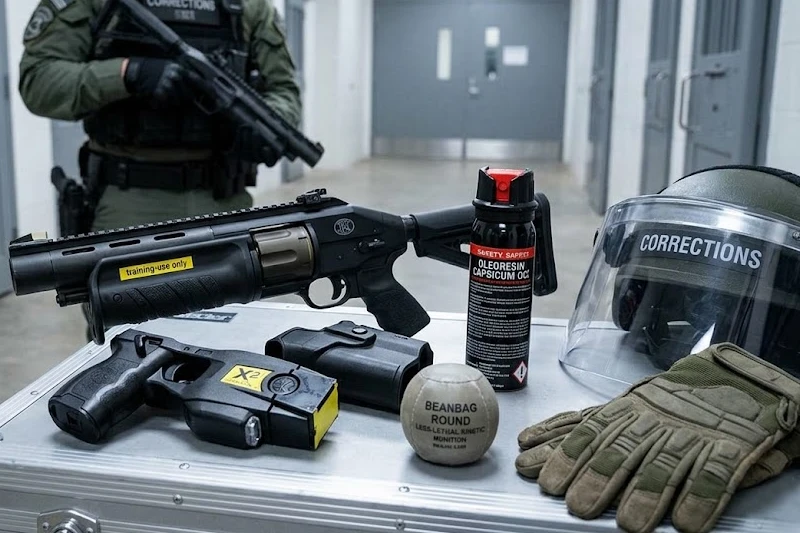
Less-lethal tools sit between empty-hand control and lethal force. They are meant for situations where verbal de-escalation has not resolved the threat and a higher level of physical control is required, but deadly force is not justified.
This is where launcher systems, defender platforms, and less-lethal ammunition come in as documented, trained-for response options rather than a first resort.
A department building out this tier of its continuum typically needs a mix of equipment types to match different scenarios: a 37mm launcher for standoff distance in crowd or riot response, a compact defender platform for close-range encounters, and a range of less-lethal ammunition suited to different deployment distances.
Selecting equipment for this tier should follow the same logic as the rest of the continuum: match the tool to the documented threat level, and train officers on exactly when to use it.
These products are available only to police, corrections, military, and other government-authorized agencies, consistent with how the continuum itself is meant to function within a controlled chain of command.
Identifying the Threshold for Excessive Force
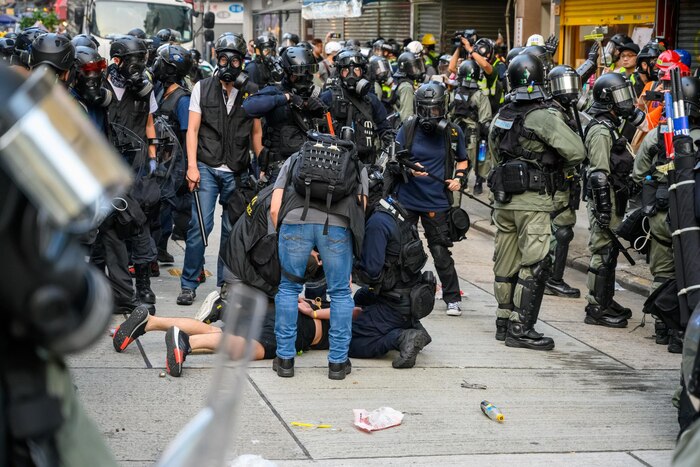
Police use of force becomes excessive when the level applied goes beyond what the situation reasonably requires, whether that means skipping lower-tier options, using a tool outside its intended scenario, or continuing force after a subject is compliant.
This is why continuum training exists: it gives officers and reviewers a shared standard for what “reasonable” looks like at each stage, rather than leaving that judgment undefined until after an incident.
Excessive force findings usually trace back to a training or documentation gap, not the equipment itself. Departments that keep clear records of continuum-based training and document why they selected a specific type of less-lethal ammunition in a given incident are in a far stronger position during any post-incident review.
Equip Your Agency for the Use of Force Continuum
The use of force continuum works best as a living training standard, not a static poster in a briefing room.
Less Lethal DefenX, powered by Lampered Less Lethal, is a Canadian developer and manufacturer based in Sarnia, Ontario, built on decades of engineering experience. We supply launchers, defenders, ammunition, and grenade systems to police, corrections, military, and other government-authorized agencies.
Contact us today to talk through which systems fit your department’s continuum and training program.
FAQs
Is It Illegal for Police to Use Excessive Force?
Yes. Force that exceeds what a situation reasonably requires violates use-of-force policy and, depending on the jurisdiction, can carry legal consequences for the officer and department involved. This is why continuum-based training and clear incident documentation matter.
What Is Police Use of Force?
Police use of force is any physical intervention an officer uses to control a subject, resolve resistance, or protect public and officer safety, ranging from a firm verbal command to lethal force at the top of the continuum.
What Is Verbal De-Escalation on the Use of Force Continuum?
Verbal de-escalation is the lowest-level response option on the continuum. It uses clear communication, distance, and time to resolve a situation without physical contact, and officers are trained to use it first.
What De-Escalation Strategies Do Agencies Use Before Applying Force?
Common strategies include slowing the pace of an interaction, creating physical distance, assigning a single officer to communicate, and calling in specialized units for mental health or crisis situations before force becomes necessary.
What De-Escalation Techniques Are Officers Trained In?
Officers typically train in active listening, tactical communication, time and distance management, and scenario-based decision drills, often modeled on programs like ICAT, which pair these techniques with continuum-based force options.