Agencies regularly work in unpredictable environments where decisions must balance safety, operational control and risk mitigation. In these situations, terminology becomes important.
Two phrases that often appear in public discourse are “less lethal” and “non-lethal.” Although they sound similar, the two terms have very different meanings.
Agencies must clearly understand this distinction because it influences equipment selection, operational planning, public communication, and internal policy development.
This blog post breaks down the difference between less-lethal and non-lethal, why the distinction matters and how agencies use these classifications to structure safe and effective response strategies.
Understanding What Non-Lethal Actually Means
The term “non-lethal” refers to tools or technologies that are not intended to cause death under any circumstances. In theory, non-lethal devices would be incapable of causing a fatal outcome, even under incorrect or extreme conditions.
In practical reality, very few tools meet this definition. Impact-based devices, chemical irritants, acoustic tools and diversionary systems all carry at least some level of risk, even if that risk is low.
For this reason, the term ‘non-lethal’ is generally considered inaccurate in professional environments. Agencies avoid the phrase because it creates unrealistic expectations about performance and outcomes. Any tool used to influence behaviour, create movement, or apply force carries some level of risk, even when designed to minimize it.
Non-lethal is therefore more of a conceptual category than a practical one. It describes intent, not a guaranteed outcome. This is why most agencies do not use the phrase in official documentation.
What Less Lethal Means in Operational Use
Less lethal is the accepted professional term for equipment designed to minimize the risk of fatality while still providing a measurable effect. These tools deliver controlled force, sensory impact or area disruption predictably and more safely. They are designed with specific energy thresholds, performance profiles, and engagement distances that support responsible use in agency operations.
These tools are not risk-free. Instead, they are intentionally built to deliver the lowest practical risk while still allowing agencies to maintain order, manage movement, or control escalating situations.
How Less Lethal and Non-Lethal Differ in Operational Effect?
Although the terms are often conflated or mixed together in media or public conversations, their operational meanings are very different.
1. Risk Profile
Non-lethal implies zero risk of serious injury, which is not achievable in real-world conditions. Less lethal acknowledges reduced but present risk.
2. Purpose
Less-lethal tools are intended for behaviour influence, crowd control, area denial, or tactical disruption. Non-lethal tools, if they existed in a literal sense, would have no capacity to cause harm even if misused.
3. Operational Planning
Agencies incorporate less-lethal tools into their planning because their capabilities and effects are known. Non-lethal, being inaccurate, does not serve an operational purpose.
Examples That Illustrate the Difference
Chemical Irritant Rounds
These rounds disperse OC powder or similar materials. They influence large groups and help shift the movement. They pose low risk when used according to established guidelines, but are not risk-free. Therefore, they are less lethal, not non-lethal.
Kinetic Impact Rounds
These rounds are designed with controlled energy output. They interrupt aggressive actions or guide movement. They remain less lethal because impact always carries a potential for unintended injury.
Aerial Burst Irritant Systems
These systems disperse irritants from above. They offer wide coverage but must be deployed with awareness of wind and the environment. They are less lethal due to low physical-force application, but the category still acknowledges inherent risk.
Acoustic-Based Distraction Tools
These devices use loud sound to create momentary disorientation. They are low risk but not risk-free, which makes them less lethal.
No tool listed above fits the definition of non-lethal. Each has an effect that could contribute to harm if circumstances align unfavourably.
How Agencies Apply This Distinction in Real Events
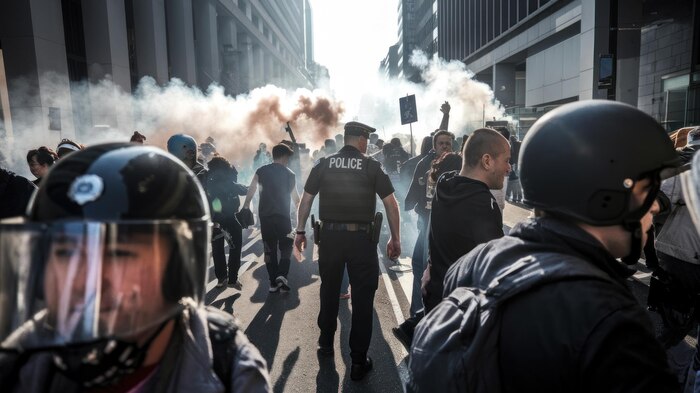
During crowd control, riot lines, facility disturbances or perimeter operations, agencies use less-lethal tools to influence behaviour.
Classification helps determine the type of system to use in each situation. For example:
- Area saturation tools for large groups
- Controlled impact for targeted influence
- Irritant tools for access denial
- Aerial burst systems for open spaces
- Acoustic tools for momentary disruption
Each falls within the less-lethal category because it carries a measured risk and serves a controlled purpose.
None is labelled non-lethal, because none offer zero-risk outcomes.
Conclusion
Less lethal and non-lethal are not interchangeable terms. Non-lethal describes an ideal that does not exist in practical agency operations.
Less lethal is the accurate, responsible and professional classification that acknowledges the controlled, reduced and managed risks associated with these tools.
Understanding the difference helps agencies communicate clearly, plan effectively and maintain public trust by using precise terminology that reflects real-world performance.