Mutual aid crowd control works when partner agencies agree, before they deploy together, on who commands, whose use-of-force rules apply, which less-lethal munitions officers may carry and how stock will be counted and replaced. Mutual aid is the temporary loan of officers and equipment from one police service to another when an event outgrows local resources.
In crowd control, that usually means public order units from several services holding one perimeter, each arriving with its own launchers, rounds, reporting forms and habits. Without a shared plan, those differences surface on the line.
When the event ends, the reviews begin, and they rarely stop at one agency. Commissions, oversight bodies and civil courts will ask which officer fired which round, under whose authority, and whether that officer had qualified on the munition in their hands. A visiting officer who followed home policy while the host expected something else leaves both services exposed.
Partners who settle these questions on paper, train together and track munitions at the staging area give every officer a defined line to work within and give reviewers a record they can follow.
The sections below follow a mutual aid deployment from the written agreement through training, staging and resupply.
Mutual Aid Crowd Control Starts With a Written Agreement
In Ontario, section 19 of the Community Safety and Policing Act, 2019 lets a chief of police request temporary assistance from another chief and requires notice of the circumstances, timeframe, and extent of help needed. The mutual aid agreement police services sign in advance should cover the less-lethal detail that a notice leaves out.
| Term | What the agreement should settle |
| Command | Who holds incident command and who can authorize less-lethal deployment |
| Use-of-force rules | Which policy, thresholds and reporting forms visiting officers follow |
| Approved munitions | Which launchers and rounds may be carried, listed by calibre and type |
| Supply and cost | Who replaces munitions used and how costs are recovered |
| Records | How each round fired is logged and shared after stand-down |
Settling Policy Before Officers Cross Jurisdictions
Policy gaps show up fastest under pressure. After the 2022 convoy protests, the Public Order Emergency Commission recommended that Ontario set out models of integrated or unified command for major events. In its response to the Commission, the federal government agreed that common terminology and common command models let officers from different services fold into a single command structure.
Force options need the same treatment. A mutual aid use-of-force policy, agreed before the event, should name the reporting forms visiting officers complete, where each munition sits on the use-of-force continuum and who reviews every deployment afterward.
Where home and host rules differ, the agreement should state which one governs before anyone deploys. Each mutual aid agreement police chiefs sign should attach that policy, so nobody has to interpret it mid-event.
Joint Training and Matched Equipment
Joint crowd control training puts partner units through the same scenarios before they meet on a real line. It exposes differences in commands, formations and munition choices while there is still room to fix them. Run it on a schedule partners agree in writing, and again after any change in equipment or policy.
Less-lethal interoperability goes a step further. When partners carry the same launcher calibre and round types, a visiting officer can draw from host stock if supply runs short, and both inventories can be counted the same way.
Agencies reviewing launcher options with neighbouring services should settle on calibre first and munition range second. That shared baseline also simplifies joint crowd control training, since every officer qualifies on the same platforms.
Counting Munitions at the Staging Area
In mutual aid crowd control, visiting stock needs its own record from the moment it arrives. A staging area count should follow these steps.
- Record each visiting officer’s name, service and current qualifications.
- Count rounds by type, calibre and lot number, and check each against the approved list.
- Tag visiting stock so it cannot be mixed with host stock.
- Log every issue and return against a named officer.
- Recount at stand-down and reconcile any difference with the reports required under the mutual aid use-of-force policy.
Also Read: Types of Crowd Control Equipment Used by Law Enforcement: A Complete Guide
Keeping Supply Lines Open Over Several Days
Prolonged unrest drains stock faster than routine orders replace it. Plan munitions resupply during civil unrest before the first shift, deciding which partner holds reserve stock, how quickly it can move, who signs for it and how it travels under dangerous goods rules.
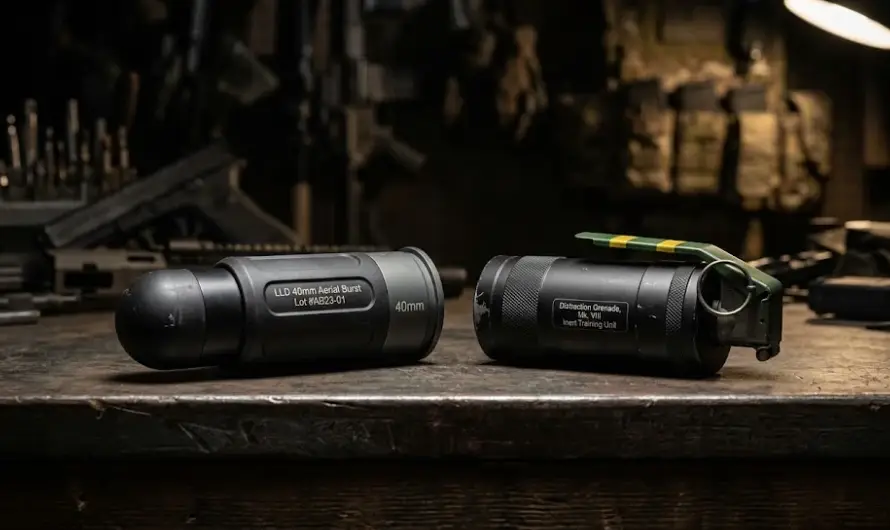
Shared device types across partners make that plan easier to run. The LLD Lightweight Aerial Burst Distraction is listed for standard 37mm and 40mm launchers, so partners on either calibre can stock the same device type. Confirm the calibre on every case before pooling reserves, since 37mm and 40mm cartridges are not interchangeable, and settle it early as part of less-lethal interoperability.
Set a reorder point for each munition type, so munitions resupply during civil unrest starts when stock falls below it, not when an officer runs dry.
Planning the Partnership Before the Call Comes
Mutual aid crowd control holds together when the agreement, training, staging count and resupply plan are settled before partner units deploy.
Less Lethal DefenX launchers and munitions come from Lampered Less Lethal, based in Sarnia, Ontario, and ship to authorized services in the Middle East, Europe, North America, Asia and Africa. Output runs between 300 and 600 rounds per hour, and every round clears 12 to 17 manufacturing steps before it ships. Orders are accepted only from police, military, corrections and other agencies holding government authorization, never from the public.
Get in touch to plan a matched launcher and munitions order with your mutual aid partners.
Frequently Asked Questions
Whose Use-of-Force Policy Applies When Officers Deploy Under Mutual Aid?
That depends on the law where officers are deployed and on the terms partners agree in advance. The written agreement should name the governing policy and reporting rules, so no officer has to work it out during the event.
What Should a Mutual Aid Agreement Say About Less-Lethal Munitions?
It should list approved launchers and rounds by calibre and type, who can authorize their use, how rounds are logged, who replaces what is used and how deployment records are shared afterward.
How Do Agencies Inventory a Visiting Unit’s Less-Lethal Munitions at the Staging Area?
Count stock on arrival by type, calibre, and lot; tag it as visiting stock; log each issue and return against a named officer; then recount at stand-down and reconcile with use-of-force reports.
How Can Agencies Avoid Running Out of Less-Lethal Munitions During Prolonged Unrest?
Agree in advance which partner holds reserve stock, set reorder points for each munition type and arrange transport and sign-off ahead of time, so resupply begins well before stock runs low.
Why Do Mutual Aid Partners Benefit From Standardizing on the Same Launcher Calibre?
A shared calibre lets visiting officers draw from host stock, simplifies counting and resupply, and reduces the risk of loading a round into the wrong launcher.