Modern law enforcement operates within a structured framework where every use of force must be justified, proportionate, and accountable. Understanding the difference between less lethal vs lethal force is essential for evaluating how agencies respond to threats while maintaining control and minimising harm.
This comparison is not simply about equipment. It reflects a broader system that balances operational effectiveness with legal and ethical boundaries. From tactical less lethal weapons to conventional firearms, each option exists within a clearly defined hierarchy known as the police force continuum.
Understanding Less Lethal and Lethal Force
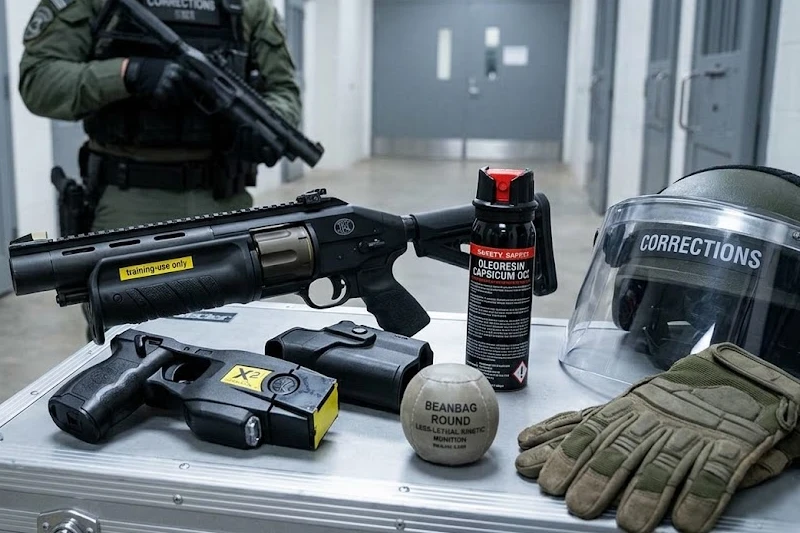
At a fundamental level, the distinction between lethal vs non lethal weapons lies in their intended outcome. Less lethal weapons are designed to reduce the likelihood of death or permanent injury while still influencing behaviour or stopping a threat. These tools include kinetic impact munitions, chemical irritants, and conducted energy devices, all engineered to provide controlled effects that allow agencies to stabilise situations without escalating to fatal outcomes.
Lethal force, by contrast, refers to any action that is likely to cause serious bodily harm or death. Firearms represent the most widely recognised example, but any method capable of producing fatal consequences falls within this category. The distinction is therefore based on outcome probability rather than the physical appearance of the weapon.
The Use of Force Continuum Explained
To fully understand the relationship between less lethal and lethal force, it is necessary to examine the use of force continuum, a structured model that guides how and when force should be applied. This framework progresses from minimal intervention to higher levels of force depending on the situation.
The continuum typically begins with officer presence and verbal communication, moves through physical control techniques, and then introduces less lethal options before reaching lethal force as a final measure. Each stage reflects an escalation in response based on the level of threat or resistance encountered.
Rather than functioning as a rigid checklist, the continuum is dynamic. Officers may move up or down the scale as conditions change, always aiming to apply the least amount of force necessary to resolve the situation safely and effectively.
Key Differences Between Less Lethal and Lethal Force
Purpose and Outcome
The primary purpose of less lethal weapons is to influence behaviour and gain control without causing permanent harm. These tools aim to disrupt, deter, or stabilise a situation while preserving life and reducing long-term consequences.
Lethal force serves a fundamentally different purpose. It is intended to neutralise a threat that presents an immediate risk of serious injury or death. Once applied, its effects are often irreversible, which is why it is reserved for extreme situations.
Risk Level
Less lethal systems are designed to reduce the probability of fatal outcomes, but they do not eliminate risk entirely. Even properly engineered tools can cause serious injury under certain conditions, which is why they are referred to as “less lethal” rather than “non-lethal.”
Lethal force carries a significantly higher level of risk, with a strong likelihood of severe injury or death. As a result, it is subject to stricter legal scrutiny and operational limitations.
Application Within the Continuum
Less lethal tools occupy the intermediate levels of the force continuum. They provide a critical bridge between physical control and lethal intervention, allowing agencies to respond proportionately to evolving situations.
Lethal force represents the highest level within the continuum and is only used when lower levels of force are insufficient or inappropriate. It is considered a last resort rather than a routine option.
Operational Flexibility
Less lethal weapons offer greater flexibility in dynamic environments. They allow agencies to scale responses based on changing conditions, such as crowd behaviour or individual resistance.
Lethal force does not provide this same adaptability. Its application is binary and final, which limits its use to situations where no other viable options exist.
Legal Boundaries and Justification
The legal framework governing force is built on three core principles: necessity, proportionality, and reasonableness. These principles ensure that all use of force remains justified within the law.
Necessity
Force must only be used when required to achieve a legitimate objective. If a situation can be resolved without force, its use is not justified. This principle encourages restraint and prioritises de-escalation wherever possible.
Proportionality
The level of force must correspond to the level of threat. Less lethal options are preferred when they are sufficient to control the situation. The force continuum reinforces this principle by promoting gradual escalation rather than immediate high-level intervention.
Reasonableness
Legal standards assess whether a reasonable officer in the same situation would have made the same decision. This evaluation considers the urgency, uncertainty, and complexity of real-world conditions.
Lethal force is generally justified only when there is an immediate threat of serious harm or death and no alternative options are available.
Role of Less Lethal Weapons in Modern Policing
Less lethal solutions for police play a critical role in reducing reliance on lethal force. By providing intermediate options, they allow agencies to respond more precisely to varying threat levels.
These systems enable controlled engagement at distance, reduce the need for physical confrontation, and improve management of complex environments such as crowd control scenarios. Their availability allows for earlier intervention, which can prevent situations from escalating to critical levels.
As a result, less lethal weapons have become an essential component of modern operational strategy.
Balancing Control and Accountability
The distinction between lethal and less lethal force is closely tied to accountability. Agencies must demonstrate that their actions align with established frameworks and legal standards.
Less lethal weapons support this requirement by offering options that reduce harm while maintaining control. Their use helps demonstrate proportionality and adherence to policy, particularly during post-incident review.
At the same time, every use of force must be documented and evaluated. Accountability ensures that decisions remain consistent with both operational guidelines and public expectations.
Common Misconceptions
One common misconception is that less lethal weapons are completely safe. In reality, they are designed to reduce risk, not eliminate it. Improper use or unpredictable conditions can still result in serious outcomes.
Another misconception is that lethal force is simply a stronger version of less lethal options. In practice, the difference is categorical rather than incremental. Lethal force represents a fundamentally different level of response within the continuum.
Understanding these distinctions is essential for accurate evaluation of force decisions.
Read More: The Future of Less Lethal Technology
Why the Distinction Matters
The difference between less lethal vs lethal force has direct implications for operational effectiveness and public trust. When agencies apply force appropriately, they maintain control while minimising harm.
The force continuum provides a structured framework to achieve this balance. It ensures that each level of response is justified by the situation and that escalation occurs only when necessary.
By integrating less lethal tools into this system, agencies gain the ability to respond with precision rather than intensity.
Conclusion
The comparison between less lethal vs lethal force highlights the importance of structured decision-making in modern law enforcement. Less lethal weapons provide controlled, intermediate options that support proportional response and reduce the likelihood of severe outcomes.
Lethal force remains a necessary but highly restricted option, reserved for situations where immediate threats to life cannot be addressed through other means. Legal frameworks emphasise necessity, proportionality, and reasonableness to ensure that its use remains justified.
Understanding these differences allows decision-makers to apply force effectively while maintaining accountability. Within the broader police force continuum, each level serves a defined purpose, contributing to a system that prioritises control, safety, and measured response.