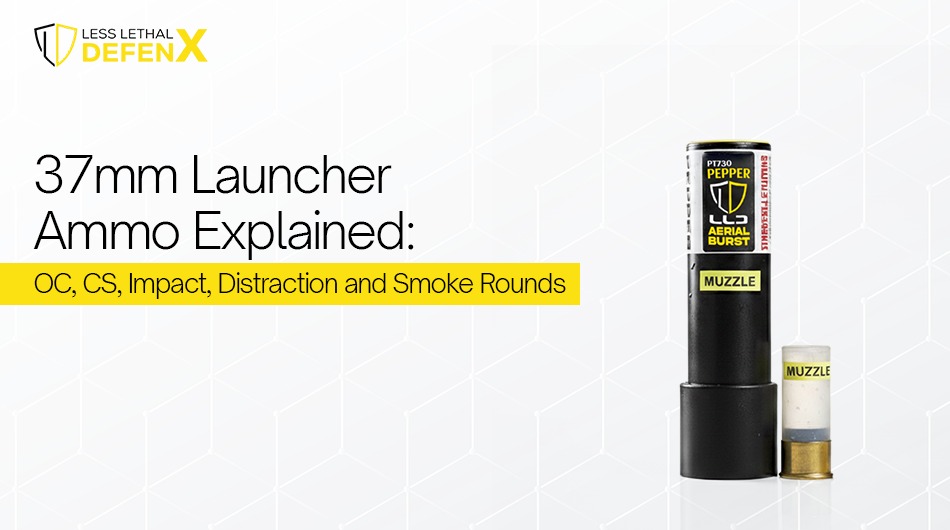
37mm launcher ammo falls into five working categories: OC pepper, CS tear gas, kinetic impact, distraction, and smoke. Each one leaves the same 37mm barrel but does a different job once it lands. An impact round strikes one person. A chemical round puts an irritant into the air.
A distraction round produces flash and sound, and a smoke round screens or signals. The launcher stays the same across all five, so the real procurement decision sits in the munitions an agency stocks, how many of each, and which officers are qualified to fire them.
Ammunition choices tend to get less scrutiny than launcher choices, yet they carry more of the risk. Two officers carrying identical launchers can produce very different results depending on what is loaded. An after-action review will look at whether the payload matched the situation: an outdoor irritant fired indoors, an impact round used where a distraction device would have worked, a pyrotechnic round near dry grass.
Each of those is a stocking and training question before it is an operational one. A clear munitions list, matched to written policy, gives supervisors something firm to train against and gives reviewers something firm to measure against.
The sections below go payload by payload, sort out the terms buyers often mix up, and close with sizing and compatibility checks.
37mm Launcher Ammo by Payload Type
Most 37mm launchers have a smooth bore and accept many types of 37mm rounds, so the payload defines what each one does. The LLD 37 mm launcher, for example, is listed as accepting OC, CS, rubber impact, and distraction munitions.
OC Pepper Rounds
OC (oleoresin capsicum) is an inflammatory agent extracted from hot peppers. It causes burning in the eyes, nose, and throat and makes the eyes close involuntarily. The 37 mm Aerial Burst Pepper travels a set distance, bursts overhead, and releases a cloud of OC powder across an area. The manufacturer lists it for outdoor use only and gives an irritation period of 10 to 30 minutes.
CS Tear Gas Rounds
CS is a synthetic irritant, the compound most people mean when they say tear gas. It tends to hang in the air longer than OC powder, so ventilation and decontamination are part of the deployment plan. Under Canada’s Criminal Code weapons regulations (SOR/98-462), any device designed to incapacitate a person by discharging tear gas or another gas, spray, or powder is a prohibited weapon. That classification covers OC and CS munitions alike, and it is why both are restricted to authorized agencies.
Kinetic Impact Rounds
Impact rounds deliver blunt force to one person rather than an area. The 37mm WASP fires a single rubber projectile, is rated by the manufacturer from minus 50°C to plus 50°C, and works in both single-shot and multi-shot 37mm launchers. Impact rounds call for the tightest training standards of any 37mm payload. Ontario’s G20 Systemic Review Report, published by the Office of the Independent Police Review Director in 2012, examined the 2010 Toronto summit, where police used rubber bullets and tear gas at Queen’s Park. It found that many people in the crowd had not heard the order to disperse and were not given time or room to leave.
Distraction Rounds
Distraction munitions produce a bright flash and a sharp report to disorient people for a few seconds. Launcher-fired versions detonate in the air above the target area, so officers do not need to close the distance to throw a device. Listed outputs on current products sit around 135 to 145 decibels.
Smoke Rounds
37mm smoke rounds release white or coloured smoke to screen movement, mark a location, or show wind direction before a chemical deployment. Most burn pyrotechnically and run hot, so use them outdoors and keep them away from dry vegetation or fuel.
How Grenades, Rounds and Flares Differ
Procurement requests often use these three terms loosely, and the difference matters for ordering and for policy.
- Rounds. A round is a complete cartridge fired from the launcher, with a propellant charge and a payload in one casing.
- Grenades. 37mm grenades carry a payload that disperses or detonates at the target area, such as an aerial burst irritant, smoke, or flash and sound. Some are launcher-fired, and others are hand-thrown, so confirm the delivery method for each product.
- Flares. 37mm flares are signalling or illumination devices. They burn at very high temperatures, are not designed as less lethal munitions, and have no place on a use-of-force inventory as an option against people.
The LLD Lightweight Aerial Burst Distraction shows how the categories overlap. It is sold as a grenade, fired from standard 37mm and 40mm launchers, and carries no projectile. Keep flares on a separate inventory line from less lethal stock so they are never loaded by mistake.
Also Read: Aerial Burst Pepper Rounds: How Law Enforcement Disperses Crowds Without Direct Contact
Sizing and Compatibility Checks
37mm in inches works out to about 1.46 inches, which is why some launchers and suppliers describe the calibre as 1.5 inches. That near-match causes confusion with 40mm (about 1.57 inches), a separate calibre with its own launchers and cartridges. Some products come in both sizes, but the cartridges aren’t interchangeable.
Before ordering 37mm launcher ammo, confirm four things:
- The round is listed for your specific launcher model, including multi-shot launchers with fixed cylinder lengths.
- Each payload has an indoor or outdoor rating that matches where your teams deploy.
- Shelf life and storage temperature limits fit your armoury conditions.
- Every officer who carries the round is qualified on that specific payload.
Agencies building a mixed stock can compare current options across the ammunition range before requesting quotes.
Building a 37mm Munitions List for Your Agency
Choosing 37mm launcher ammo comes down to matching each payload to a defined situation, then stocking and training to that match.
Less Lethal DefenX operates out of Sarnia, Ontario, under Lampered Less Lethal, and manufactures its munitions in Canada. Production runs through 12 to 17 manufacturing steps per round at 300 to 600 rounds per hour, and the company ships to authorized agencies in North America, the Middle East, Europe, Africa, and Asia. All 37mm munitions are sold only to police, corrections, military, and other government-authorized agencies.
Contact us today to build a 37mm munitions order around your agency’s deployment policy.
Frequently Asked Questions
What Types of 37mm Rounds Can a 37mm Launcher Fire?
Standard smooth-bore 37mm launchers fire OC pepper, CS tear gas, kinetic impact, distraction, smoke, and signal cartridges listed for that model. Check cartridge length compatibility on multi-shot launchers before mixing suppliers.
What Is the Difference Between 37mm Grenades and 37mm Rounds?
A 37mm round is the full cartridge loaded into the launcher. A 37mm grenade is the payload device (released via launcher or thrown by hand) that bursts at the target area to deploy irritants, smoke, or sound.
Are 37mm Flares the Same as Less-Lethal 37mm Rounds?
No. Flares are pyrotechnic signalling and illumination devices, not less-lethal force munitions. They reach extreme temperatures that cause severe burns or fires and should be stored and logged separately.
What Are 37mm Smoke Rounds Used For?
Smoke rounds screen officer movement, mark landing/rally points, and assess wind direction before deploying chemical irritants. They are non-irritant pyrotechnics designed primarily for outdoor use.
How Big Is 37mm in Inches?
37mm is approximately 1.46 inches (often rounded to 1.5 inches by suppliers). It is distinct from 40mm (approx. 1.57 inches), so verify the launcher’s marked calibre before ordering rounds.