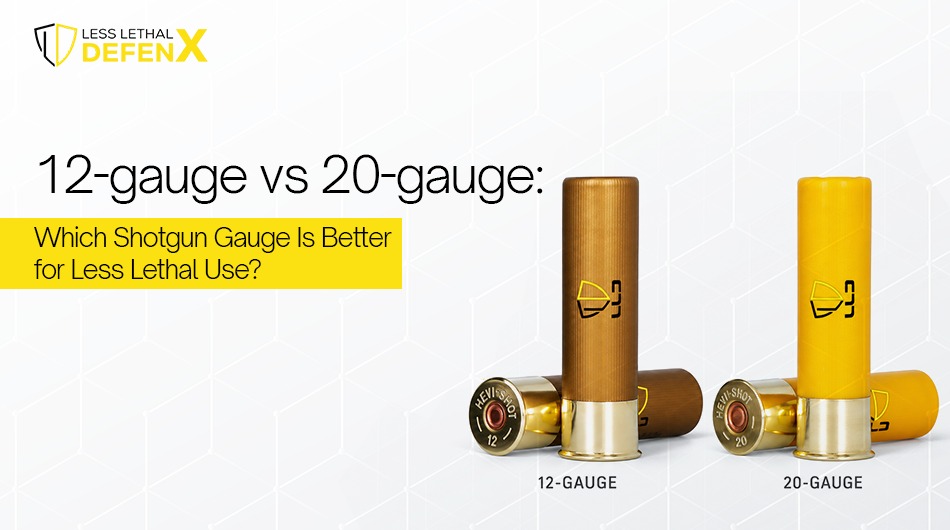
The 12-gauge vs 20-gauge choice for less-lethal use comes down to three things: how much payload each shell carries, how much recoil the officer has to manage, and how many less-lethal loads exist in each size. A shotgun’s gauge describes the width of its bore.
A 12-gauge bore is wider than a 20-gauge bore, so 12-gauge shells hold heavier projectiles and larger chemical payloads, while 20-gauge shells are smaller, lighter, and usually softer to shoot. Both sizes carry rubber impact, OC, and distraction rounds. Neither is better across the board. The right answer depends on who carries the shotgun and what it is meant to do.
Gauge choice looks like a technical detail, but it shapes a whole program. It decides which rounds an agency can stock, how quickly a new officer can qualify, and how reliably a smaller officer hits the target under stress.
It also fixes the training load for years, because every gauge an agency adds brings another set of rounds, another qualification standard, and another storage line. When a deployment is reviewed, two of the first questions are whether the officer could control the platform and whether the round suited the job. The gauge decision answers part of both before any round is fired.
Below is a plain explanation of gauge sizes, a direct comparison of the two, and the policy points that decide which one fits.
What Shotgun Gauges Mean?
Shotgun gauges come from an old measurement: the number of lead balls, each the width of the bore, that together weigh one pound. Twelve such balls match a 12-gauge bore, and twenty match a 20-gauge bore, which is why the higher number means the narrower gun. The .410 is the exception, measured in inches rather than gauge.
The shotgun gauge chart below gives nominal bore diameters for common sizes. The 10- and 12-gauge figures are industry-standard values cited by the RCMP’s Canadian Firearms Program, and the others are approximate.
| Gauge | Nominal bore | Typical use |
| 10 | 19.69 mm | Waterfowl hunting, rare in policing |
| 12 | 18.42 mm | Most common police shotgun, widest less lethal range |
| 16 | about 16.8 mm | Uncommon today |
| 20 | about 15.6 mm | Lighter platforms and compact launchers |
| 28 | about 14.0 mm | Sporting use |
| 0.41 | about 10.4 mm | Measured as a calibre, not a gauge |
The RCMP uses those same figures to confirm that standard 10- and 12-gauge shotguns sit below the 20 mm bore threshold in Canada’s 2020 firearms prohibition.
12-Gauge vs 20-Gauge: Size, Payload and Recoil
In a 12 vs 20-gauge comparison, the 12-gauge bore is close to 3 mm wider. That extra width lets a 12-gauge shell carry a heavier impact projectile or a larger chemical charge. The smaller shell still does the job at close range, and rounds such as the 20 Gauge Pepper Muzzle are built around that shorter working distance.
Recoil follows the payload. A heavier projectile produces more rearward push, so a 20-gauge round of the same type usually kicks less. Gun weight matters too. A light 20-gauge can feel as sharp as a heavy 12-gauge, so agencies should test-fire both on the platforms they would actually issue.
The trade-off is easy to state. The 12-gauge gives more payload per round and more load options. The 20-gauge gives a smaller, lighter package that more officers can shoot accurately with less training time.
Where a 20-Gauge Shotgun Fits in a Less-Lethal Program
A 20-gauge shotgun suits officers who find 12-gauge recoil hard to control, teams that work in vehicles or tight interiors, and agencies that want a compact launcher alongside their existing shotguns. Smaller shells also mean more rounds per pouch for the same carried weight.
The 20-gauge less-lethal range now covers the main jobs: rubber impact, OC, distraction and breaching. The 20 Gauge Door Breaching Round, for example, is built for shotguns in that gauge approved for breaching work. The weak point is choice. Fewer manufacturers make 20-gauge less-lethal rounds, so agencies should confirm supply and lead times before committing.
Where 12-Gauge Still Leads
Many agencies already own 12-gauge shotguns and already train officers on them. Converting part of that fleet to dedicated less-lethal use, with a distinct colour and marking, usually costs less than adding a new platform. The 12-gauge also has the widest selection of less-lethal rounds, from rubber impact projectiles to OC rounds such as the 12 Gauge Pepper Muzzle.
Weighed as 20-gauge vs 12-gauge on those terms, the larger gauge wins on load options and existing investment, and the smaller gauge wins on handling. Most agencies settle the question by matching those strengths to their own officers and deployment settings.
Also Read: The Use of Force Continuum: Where Less-Lethal Options Fit
Matching the Gauge to Policy and Training
A few policy points apply regardless of which gauge an agency chooses.
- Use dedicated less-lethal shotguns, marked with a distinct colour, and never load lethal ammunition into them.
- Store 12-gauge and 20-gauge rounds separately and label them clearly. A 20-gauge shell can slide past the chamber of a 12-gauge barrel and lodge there, and firing a 12-gauge round behind it can burst the barrel.
- Qualify officers on the specific gauge, round, and shotgun they will carry.
- Record the gauge and round type in every use-of-force report.
In Ontario, O. Reg. 391/23 under the Community Safety and Policing Act, 2019 sets the rules on which weapons police may carry and use, and requires a report when an officer uses a weapon on another person. Agencies running 20-gauge platforms can also stock the 20 Gauge Distraction for situations where no strike is needed.
Choosing Between the Two for Your Agency
12-gauge vs 20-gauge is a question of payload against handling: the 12-gauge carries more and offers more loads, while the 20-gauge is easier to control and carry.
Less Lethal DefenX is the Sarnia, Ontario business behind Lampered Less Lethal’s launchers and munitions, built in Canada for agencies at home and abroad. Its rounds pass through 12 to 17 manufacturing steps at production rates of 300 to 600 rounds per hour, and they ship to authorized agencies in North America, the Middle East, Europe, Africa, and Asia.
All products are sold only to police, corrections, military, and other government-authorized agencies, and are not available to the general public.
Contact us today to compare 12-gauge and 20-gauge less-lethal rounds against the shotguns your agency already issues.
Frequently Asked Questions
Is 20-Gauge vs 12-Gauge a Big Difference in Recoil?
Yes. A 20-gauge produces noticeably less recoil because it fires a lighter projectile, though gun weight also affects felt recoil.
Which Is Bigger, 12 vs 20-Gauge?
The 12-gauge is bigger. Lower gauge numbers mean wider bores (12-gauge is ~18.4 mm vs. 20-gauge at ~15.6 mm), and the two shells are never interchangeable.
What Do Shotgun Gauges Mean?
Gauge indicates how many solid lead balls matching the bore diameter equal one pound (e.g., 12 lead balls for a 12-gauge). Higher numbers mean narrower bores.
Is a 20-Gauge Shotgun Good for Less-Lethal Use?
Yes, especially for recoil-sensitive officers or close-quarters scenarios. However, it offers fewer less-lethal round choices and lower payload capacity per shot than a 12-gauge.
What Does a Shotgun Gauge Chart Show?
It lists common shotgun calibres alongside their bore diameters in millimetres or inches to help confirm ammunition and accessory compatibility.