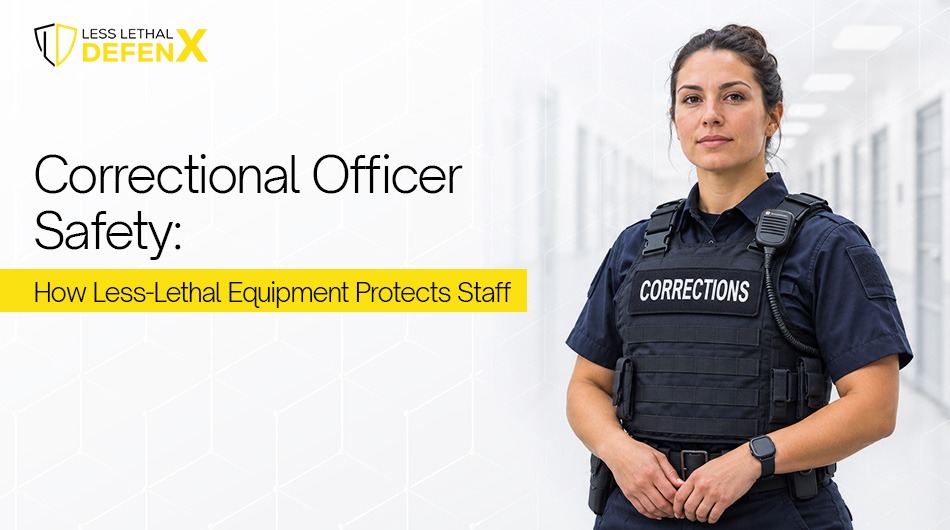
Correctional officer safety improves when staff can control a disturbance from a distance, using a tool suited to the space and training they have already practised. Less-lethal equipment in prisons and jails includes OC munitions, impact rounds and distraction devices that let officers interrupt violence without moving into hands-on range.
Distance matters inside a facility because many assaults on staff happen up close, during escorts, at cell doors and in crowded day rooms. A tool that works from across a yard or along a corridor can mean fewer officers drawn into a physical struggle.
Staff injuries leave a long paper trail. Each one can bring a workplace claim, an incident review, overtime to cover the post and, in serious cases, an inspector’s questions. Managers who issue equipment answer for that decision twice, once if staff are hurt because the right tool was missing and again if a tool was used without proper training or review. Getting both right protects officers and leaves the facility with a record it can defend.
Below, we look at where staff face the most risk, which tools suit yards and housing units, what training should come first, and how to review deployments.
Where Staff Face the Highest Risk
Ontario’s Institutional Violence in Ontario final report, which examined 2017 data, surveyed provincial correctional staff. Just over half of the correctional officers who responded said they did not feel safe at their institution, and 66% of frontline officers worried about being assaulted by an inmate at least once a week. At Toronto South Detention Centre, 43% of reported assaults and attempted assaults on staff in 2017 happened through a cell door meal hatch.
Jail safety turns on close-range moments like these. Prison safety planning starts by mapping those moments, from meal service and escorts to cell entries and yard movements.
Outdoor Yards and Exercise Areas
A yard fight can draw in onlookers within seconds. Officers on the perimeter need an option that reaches the group without sending staff in, and sound-based distraction rounds fit the job. The 12 Gauge Distraction produces a 145-decibel report with no flash, fire or fragments, which can pause a fight long enough for staff to separate the people involved. Every officer near the deployment needs hearing protection.
Open air also lets OC disperse, so yard posts can hold outdoor-rated chemical munitions where policy allows. Good jail security planning starts from the post and works back to the tool, rather than issuing the same kit everywhere.
Indoor Housing Units and Corridors
Inside a unit, distance shrinks, and ventilation becomes the limit. A wide-area irritant that suits a yard can drift along a range and reach other inmates, staff and the control post. Close-range muzzle rounds release a measured amount of OC instead. The 12 Gauge Pepper Muzzle carries 6 grams of OC powder in a 2.75-inch shell, and the manufacturer lists it for indoor use, including cell extractions.
Correctional officer equipment for units should include a ventilation plan and decontamination supplies stored on the unit, so a short deployment doesn’t turn into a unit-wide exposure.
Qualification Before Equipment Is Issued
Equipment on a post without training adds risk instead of removing it. The Ontario review found that 52% of responding correctional officers did not feel prepared to start work after being hired. The same review cautioned that security-driven measures alone will not address the causes of institutional violence, so equipment has to sit alongside de-escalation training, staffing, and proper assessment.
Before any less-lethal tool is issued, staff should complete training in:
- Use-of-force law and facility policy, including when not to deploy
- De-escalation and communication, practised in realistic scenarios
- Hands-on qualification on each platform and munition they will carry
- Decontamination and aftercare for chemical agents
- Report writing that records the munition, the distance and the reason for the choice
Qualification has to match the platform. The LLD 20 Gauge Defender holds five 20-gauge rounds behind a 1.5-inch barrel, so an officer trained only on a single-shot launcher still needs a course on it. Treat corrections officer equipment like a licence that lapses without a current qualification.
Matching issue logs to training records is one of the simplest jail security checks a facility can run, and recertification on a fixed cycle keeps correctional officer safety from resting on one course taken years ago.
Also Read: Cell Extractions: Less-Lethal Options for Confined Spaces
What a Useful Deployment Review Looks Like
When it released its 2015/16 annual report findings, the Office of the Correctional Investigator reported that 60% of the 1,833 use-of-force incidents it reviewed in federal prisons involved an inflammatory agent and warned that pepper spray had displaced less invasive ways of resolving conflict. It described most reviews as cursory, with few video recordings and weak oversight of how agents were stored, weighed and issued.
A review that protects correctional officer safety asks practical questions. Was the tool right for the space? Was anyone hurt? Did the officer have room to step back first? What should change next time? Track the answers by unit and shift. Repeated incidents at one meal hatch, for example, point to where prison safety needs a change in routine, staffing or correctional officer equipment, rather than more rounds in stock.
Equipping Officers for the Spaces They Work In
Correctional officer safety comes from matching corrections officer equipment to the yard or unit, training staff before issue and learning from every deployment, steps that also support jail safety for the people held there.
Built in Sarnia, Ontario, by Lampered Less Lethal, the Less Lethal DefenX range supplies corrections and police agencies across North America, Europe, the Middle East, Africa and Asia. Every hour, the line completes 300 to 600 rounds, each one finished after 12 to 17 manufacturing steps. Every product is restricted to corrections, police, military and other government-authorized agencies and is not available to the public.
Speak with our team about less-lethal equipment for your facility’s yards and housing units.
Frequently Asked Questions
How Does Less-Lethal Equipment Reduce Injuries to Correctional Officers?
It lets officers act from a distance, so fewer staff end up in a hands-on struggle. The benefit depends on the tool suiting the space and the officer being trained on it.
How Can Less-Lethal Tools Stop a Yard Disturbance From Escalating?
A distraction round or an outdoor-rated OC munition can interrupt a fight from the perimeter, giving staff a window to separate those involved before others join in.
Which Less-Lethal Options Suit Outdoor Exercise Yards Versus Indoor Housing Units?
Yards suit sound-based distraction rounds and outdoor-rated OC munitions because irritants disperse in open air. Housing units call for close-range muzzle rounds, backed by ventilation and decontamination plans.
What Safety Training Should Corrections Staff Complete Before Using Less-Lethal Equipment?
Use-of-force law and policy, scenario-based de-escalation, hands-on qualification on each platform and munition, decontamination and aftercare, and report writing, followed by recertification on a policy-set schedule.
How Should Facilities Review Less-Lethal Deployments to Improve Staff Safety?
Check each deployment against video and written reports, record any injuries to staff or inmates and track incidents by unit and shift. Use those trends to adjust routines, training or equipment.